
A tower crashes. A friend says "You can't play." The dog next door barks in the dark. Children aged 6 to 8 feel things big, and they don't always have the words for it. This guide is about emotions for Muslim kids: helping them name what they feel, calm down when it's too much, and make a kind choice afterwards.
It's written for parents and teachers, with a feelings word list, calm-down steps, talk prompts and a quick classroom check-in. If your child likes stories, the My Feelings chapter in our adventures follows Lina and Sami through these same moments.
Why naming a feeling helps
When a child can say "I'm frustrated" instead of throwing the puzzle, something important has happened. Naming a feeling helps children notice it, understand it and choose what to do next. Recognising your own emotions is one of the core skills in social-emotional learning frameworks such as CASEL's, and it grows with practice.
Children this age can also learn to notice body clues: a hot face, tight fists, wet eyes, a wobbly tummy, legs that can't sit still. These are useful early warnings. "My face feels hot. I think I'm getting angry."
The message we give children is simple: all feelings are okay; what we do with them matters.
A feelings vocabulary for ages 6–8
Start with a small set of clear words and add more over time. This table works well on a fridge or a classroom wall.
| Feeling | Body clues a child might notice | Something kind to do |
|---|---|---|
| Happy | Smiling, light, bouncy | Share it: "Guess what happened!" |
| Sad | Wet eyes, heavy, quiet | Get a hug or talk to someone you trust |
| Angry | Hot face, tight fists, loud voice | Pause, breathe, use calm words |
| Scared | Fast heartbeat, wobbly tummy | Tell a grown-up you trust |
| Worried | Tummy ache, can't stop thinking | Say what the worry is out loud |
| Excited | Can't sit still, big smile | Take a breath so you can listen too |
| Proud | Standing tall, warm inside | Enjoy it, and cheer others too |
| Surprised | Eyes wide, mouth open | Take a moment to see what happened |
| Left out | Alone, quiet, looking at others | Ask "Can I play?" or tell a grown-up |
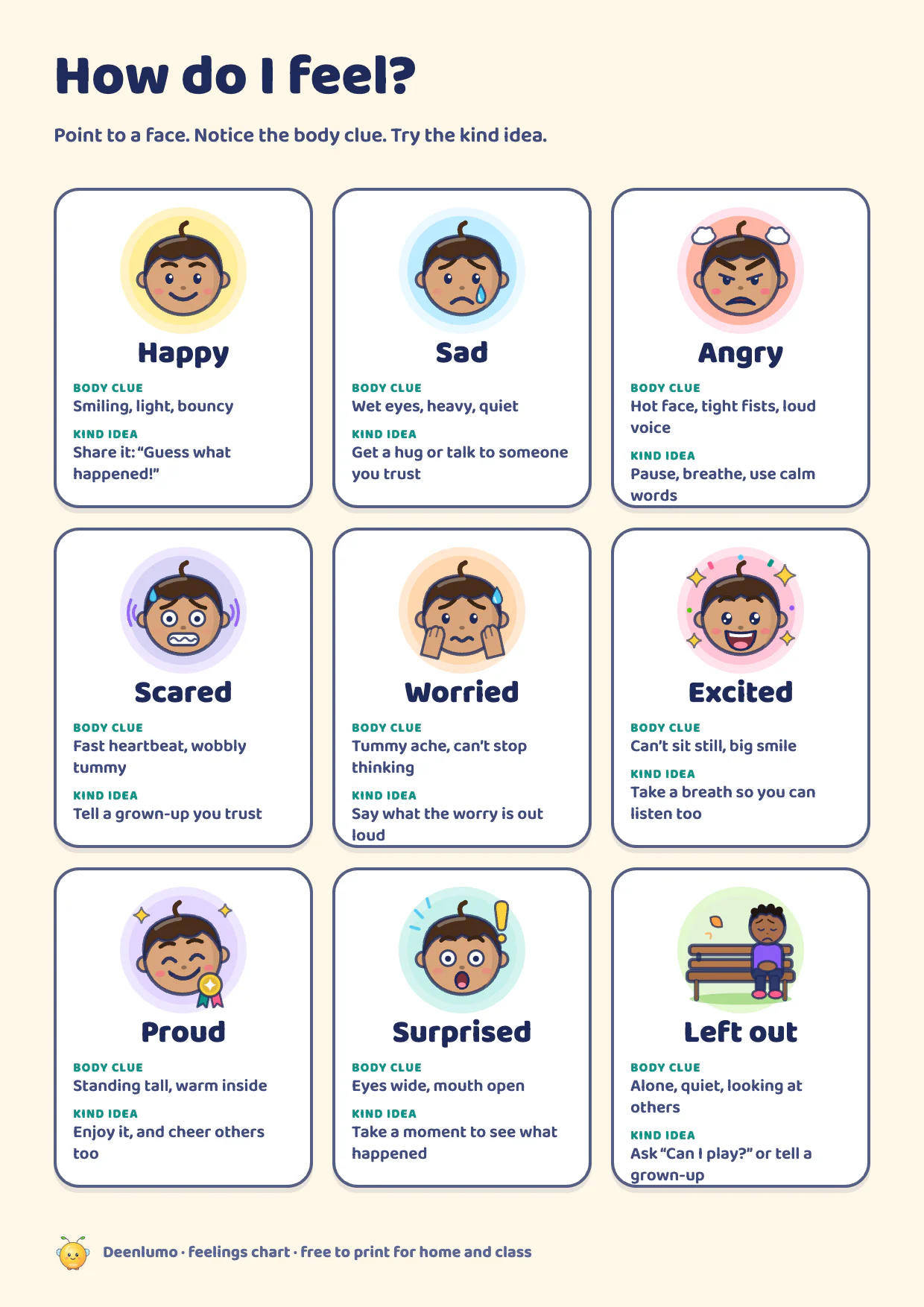
Printable: download the feelings chart (PDF, A4), with the nine faces above, a body clue and a kind idea for each. It fits on the fridge or the classroom wall.
In Deenlumo, Lumo opens a box of feeling faces and Lina tries each one in the mirror: happy, sad, angry, scared, excited and proud. It's a great game to copy at home. Make a face, and let your child guess the feeling, then swap.
Grow the list slowly. Once the basic words are easy, add a few more precise ones: frustrated, disappointed, nervous, lonely, calm, grateful. A child who can say "I'm disappointed" rather than just "I'm sad" can get more fitting help. Stories are perfect for this: pause and ask "How do you think she feels now? How can you tell?"
Calm-down steps
When feelings get big, children need a short, simple plan they've practised before they need it. Four steps are enough:
- Pause. Stop what you're doing. Hands still.
- Breathe. Three slow breaths. In through the nose, out through the mouth, as if blowing out a candle slowly. Slow breaths can help you feel calmer.
- Find a grown-up. Someone you trust: Mum, Dad, a grandparent, a teacher.
- Make a kind choice. Use calm words, ask for help, or take a break.
In the app's "Pause and Breathe" adventure, Sami and Yusuf are flying a kite when Yusuf lets go and it lands in a tree. Sami's face feels hot. Lumo whispers: "Feeling angry is okay. First, pause. Then breathe slowly." Sami breathes and counts, then asks Dad to help get the kite down. Children recognise the moment immediately.
What helps, and what doesn't, in the moment
When your child is upset, a few words go a long way. Things that usually help:
- "I can see you're really angry. I'm here."
- "Let's breathe together."
- "You can be cross, and I won't let you hit. Let's find another way."
- "Do you want a hug, or some space?"
Things that usually make it worse: "Stop crying", "It's nothing", "Big kids don't get upset", or comparing them to a sibling. Feelings that are brushed aside often come back bigger. Once your child is calm, that's the moment to talk about what happened and what they could try next time.
Practise these steps when everyone is calm, even as a game ("Let's practise our three slow breaths before dinner"). Then, in a hard moment, you only need to say "Pause and breathe" and your child already knows the plan.
Faith as comfort
For many Muslim families, faith is part of how they comfort each other. Some families make dua together when a child is worried or sad, or remind children that Allah knows how they feel. In the app, the My Feelings chapter begins with one gentle line: "Allah gave us hearts that feel many feelings."
How your family brings faith into these moments is yours to shape. Keep it warm and comforting, never a reason for a child to feel guilty about a feeling. If you'd like guidance on what to teach, your local imam or teacher can help.
For teachers: a feelings check-in
A two-minute check-in at the start of class helps children practise naming feelings and lets you spot who needs support.
- Feelings board. Put up the feelings faces. Each child places a peg or sticker by the feeling closest to theirs. Keep it optional and never comment on a child's choice in front of the class.
- Thumbs check. Thumbs up, sideways or down. Quick and private enough for shy children.
- One word round. Each child says one feeling word, or "pass".
- Follow up quietly. If a child picks sad, scared or worried, check in with them one-to-one later.
Keep the check-in light. The goal is practice with words, not a discussion of every feeling in front of everyone.
Talk prompts
Use these at bedtime, in the car or after school. One question is plenty.
- What feeling did you have today, and when?
- Was there a moment you felt proud?
- Did anything make you feel worried?
- How did you calm down when you were cross?
- Did you see someone who looked sad? What could you do?
- What helps you feel better when you're upset?
If a feeling seems very big, or lasts a long time, please talk to your child's teacher or doctor. Everyday habits help, but they're not a replacement for support when a child needs it.
FAQ
How do I teach my child to name feelings?
Name feelings out loud in everyday moments, yours and theirs: "You look frustrated that the tower fell." Use a simple feelings chart with faces, read stories and ask how a character feels, and point out body clues like a hot face or a wobbly tummy. Short, regular practice works better than one big talk.
What can my child do when angry?
Teach a simple sequence: pause, breathe slowly, count, then find a grown-up or use calm words. Practise it when your child is calm, so it's ready when they need it. Make sure they know that feeling angry is okay, but hurting people or things is not, and that a grown-up can help.
Is it OK for Muslim kids to feel sad?
Yes. Sadness is a normal human feeling, and children need to know that all feelings are okay to have. What matters is what we do with them: talking to someone, getting comfort, being gentle with ourselves. If your child seems sad for a long time, talk to their teacher or doctor.
Read next
- Islamic manners for kids: a parent's guide for ages 6–8
- Healthy screen time for Muslim families: a calm plan
---
How we wrote this. This article was written by the Deenlumo team, based on the learning plans behind the app's My Feelings chapter and general social-emotional learning guidance (CASEL). It offers everyday habits, not medical or therapeutic advice. For religious questions, ask your local imam or teacher; for concerns about your child's wellbeing, talk to their teacher or doctor.