

Screens are part of family life now: homework, video calls with grandparents, a cartoon while dinner is cooking, a learning game on the sofa. For many parents the question isn't "screens or no screens" but how to make screen time in a Muslim family healthy, calm and fair.
This guide is for parents of 6 to 8 year olds. It covers what health bodies actually say, the values many Muslim families bring to the question, how to make a plan together, and how to end screen time without a meltdown. It's practical, and there's no guilt here.
If you're curious how one learning app handles breaks and limits, our page for parents explains how Deenlumo does it.
What health bodies say about screen time for ages 6–8
The honest answer is that there is no single "right" number of minutes for a 6 to 8 year old. Here's what the main sources say (checked 2026-10-26):
- American Academy of Pediatrics (AAP). For children 6 and older, the AAP recommends consistent limits on media use and making sure screens don't take the place of sleep, physical activity and other healthy habits. It also suggests media-free times (such as meals) and media-free places (such as bedrooms). Its Family Media Plan is a free tool to set this up together.
- UK paediatricians (RCPCH). The Royal College of Paediatrics and Child Health has said it can't recommend specific time limits for children. Instead it asks families whether screen time is under control, whether it gets in the way of family plans or sleep, and suggests avoiding screens in the hour before bed. In January 2026 it wrote to ministers about the effects of excessive screen time and is keeping the question under review.
- World Health Organization (WHO). WHO's well-known screen guidance covers children under 5, not the 6 to 8 age group (WHO guidelines on physical activity, sedentary behaviour and sleep for children under 5). Its message about plenty of active play and good sleep still applies to older children.
Put simply: the experts care most about what screens push out (sleep, movement, family time, homework) and what is on the screen. That's good news, because those are things a family can plan for.
Values many Muslim families bring
Every family is different, but many Muslim parents tell us they want screen time to fit around a few things they already value:
- Balance. Islam's encouragement of moderation is something many families apply to everyday life, screens included: not too much of anything.
- Family time. Meals together, visits to grandparents and the masjid, and time to talk.
- Prayer times as natural pauses. For many families, the day already has built-in moments when everyone stops what they're doing. Those moments can double as screen breaks.
- Good company and good content. Families often want screens to show kindness and good manners, and to avoid content they wouldn't want at home.
These are family values, not rulings. If you have a religious question about screens, games or media, please ask your local imam or teacher.
Make the plan together
A plan children help to make is a plan they're more likely to follow. Sit down for fifteen minutes on a calm day (not right after an argument about the tablet) and agree three things: where screens live, when they're used, and what counts as good screen time.
Where screens live
- Keep screens in shared spaces like the living room, where a grown-up can see and hear.
- Choose a "home" for devices at night, such as a basket in the kitchen, so bedrooms stay screen-free.
- Agree on no-screen zones: the dinner table, the car on short trips, the masjid.
When: around meals, prayer and bedtime
Anchor screen time to the day's natural rhythm rather than to the clock alone:
- After homework and a bit of active play, not before.
- Not at meals. Use that time to talk.
- Paused at prayer times, if that's what your family does.
- Off at least an hour before bed. Sleep matters a lot at this age.
Write it down in words your child can read, or use pictures: a plate, a bed, a sun.
What counts as good screen time
Not all screen time is the same. Agree as a family on what kinds of screen use are welcome:
- Video calls with family
- Learning games and creative apps
- Shows you've watched together or checked first
- Looking things up together ("How do bees make honey?")
And what isn't, such as content with ads aimed at children, apps that push your child to keep playing, or shows you haven't checked. Our checklist for choosing an Islamic app can help here.
Involve your child (and everyone else)
Let your child suggest some of the rules. Children are often stricter than you'd expect, and they defend rules they helped write. Ask questions rather than announcing: "When do you think is a good time for the tablet? What should happen when it's time to stop?"
If you have children of different ages, the plan can have different times for each, with the same basics for everyone (screens out of bedrooms, off at meals). Explain the difference simply: "Your brother is older, so his homework needs the laptop." And include the grown-ups: phones away at dinner is a rule children love to enforce.
Active vs passive screens
A useful question to ask about any screen activity: is my child doing something, or just watching?
- Active screens: your child chooses, solves, creates, talks or moves. Learning games, drawing apps, video calls, making a story.
- Passive screens: your child watches while the screen does the work. Autoplaying videos, endless scrolling.
Passive isn't always bad. A family film on a Friday night is lovely. But for everyday screen time, active is usually better for 6 to 8 year olds, and it's often easier to end, because there's a natural finishing point (the end of a level, a story or a drawing).
Even active screens need a check. Look out for features designed to keep children playing: streaks that "break" if they miss a day, countdown timers, leaderboards, surprise rewards or constant notifications. These can turn a learning game into pressure.
Breaks and endings that don't cause meltdowns
Most screen-time battles happen at the end. A few small changes make endings much calmer:
- Give a heads-up. "Five more minutes, then we're going to the park." A visual timer helps.
- End at a natural point. The end of a story, level or episode is easier than mid-way.
- Have the next thing ready. A snack, a walk, a game, a job your child likes. Moving towards something is easier than leaving something.
- Build in breaks. Short breaks every 20 minutes or so help everyone. Stand up, stretch, drink some water, look out of the window.
- Same rule, same tone, every day. Children push less when they know the answer.
- Notice when it goes well. "You switched off straight away when I asked. Thank you." It works better than criticism when it doesn't.
It's also fine to be flexible. A long car journey or a poorly day may need different rules, and that's okay.
To be transparent about how we approach this: Deenlumo has no ads, no streaks to lose, no leaderboards and no timers in its games, because we don't think learning games should pressure children to keep playing. The daily limit is off by default, so each family decides what fits. A grown-up can also see the minutes their child played today and over the last 7 days. Whichever app you choose, you can test it against the same questions.
Talk about what they played
Screen time becomes family time when you talk about it afterwards. It also shows your child that you care about what they do, not just how long. Try:
- What was your favourite part?
- Was anything tricky? How did you work it out?
- Did a character do something kind or something silly?
- What would you do if that happened to you?
- Can you teach me something you learned?
Learning apps sometimes suggest questions for you. Deenlumo's grown-ups area has a "Talk about it" question for each adventure, such as "Can we practise three slow breaths together?" after a story about calming down.
Screen-free swaps
A plan works better when the alternatives are fun. Keep a short list of screen-free activities your child chose, and stick it next to the device basket:
- Build a den, then read in it
- Bake something simple together
- Visit the park with a "nature hunt" list
- Arabic letter hunt around the house
- Help in the garden or water the plants
- A board game, puzzle or drawing
- Call grandparents on the phone or visit them
A printable family screen plan
Use this template to write your plan together. Keep it to one page and put it somewhere everyone can see.
| Our family screen plan | |
|---|---|
| Where screens live | e.g. the living room; devices sleep in the kitchen basket |
| Screen-free places | e.g. bedrooms, the dinner table, the masjid |
| Screen-free times | e.g. meals, prayer times, the hour before bed |
| Good screen time for us | e.g. calls with family, learning games, a film together on Friday |
| How we take breaks | e.g. stand up and stretch about every 20 minutes |
| How we end screen time | e.g. a 5-minute warning, finish the level, then a snack |
| What grown-ups do too | e.g. phones away at dinner |
| We'll check this plan again on | (a date in a month or so) |
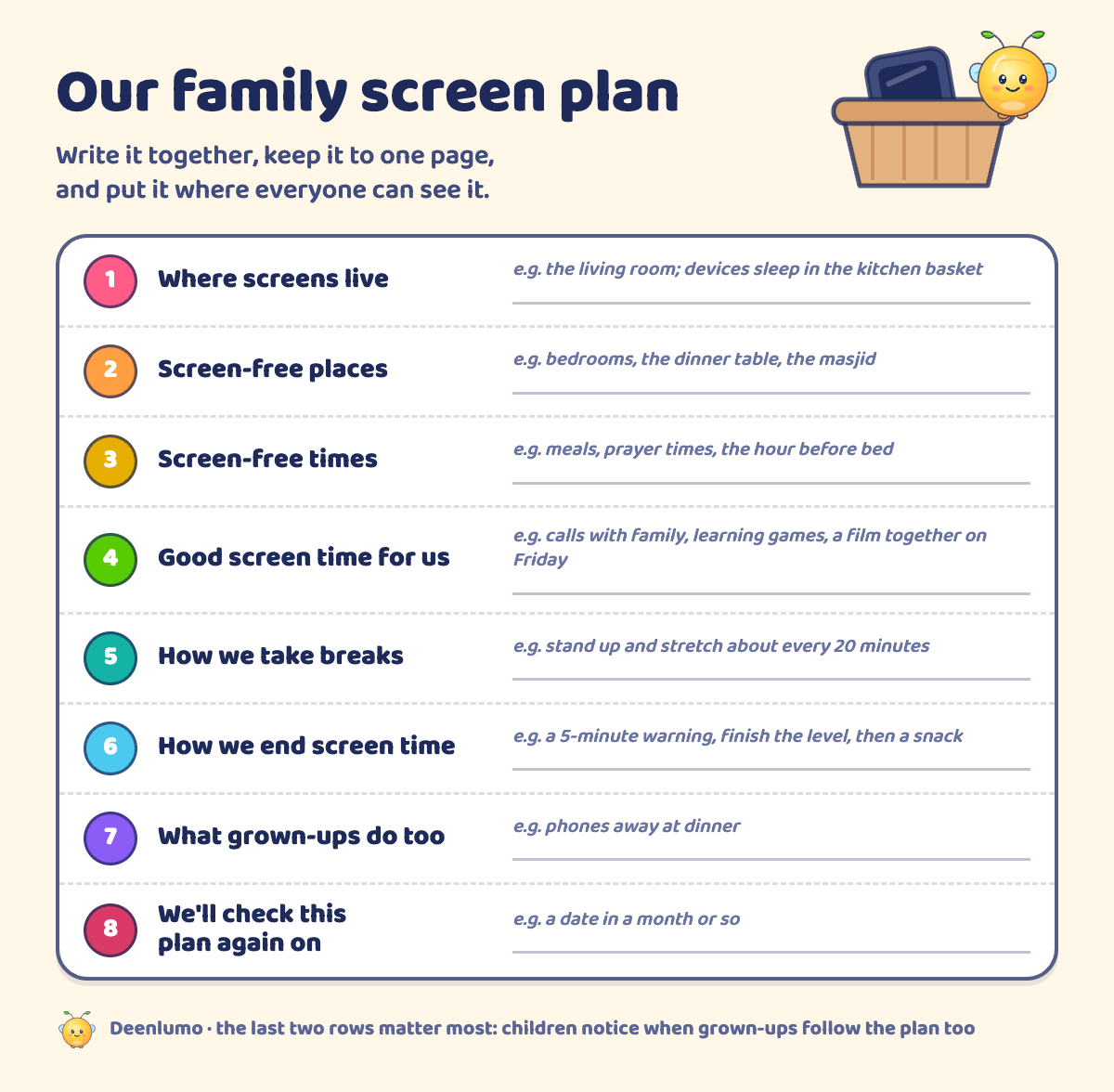
The last two rows matter. Children notice when grown-ups follow the plan too, and revisiting it after a month lets you adjust what isn't working.
FAQ
How much screen time is OK for a 7 year old?
Health bodies don't give one number for 6 to 8 year olds. The American Academy of Pediatrics recommends consistent limits that leave room for sleep, physical activity, homework and family time, and UK paediatricians focus on whether screens crowd those out. A plan you agree as a family, with screens off before bed, matters more than a fixed figure.
Are educational apps better than videos?
Often, but not always. Apps where your child thinks, chooses and solves things are usually more active than watching. What matters most is the content, whether it suits your child's age, and whether it pushes them to keep going. Check for ads, streaks and pressure, and sit with your child for the first few sessions.
How do I end screen time without tantrums?
Give a heads-up a few minutes before, agree on a clear ending point such as the end of a level or story, and have the next thing ready, like a snack or going outside. Keep your tone calm and the rule the same every day. Apps that end gently or suggest breaks help too.
Should screens be off during prayer times?
Many Muslim families like to use prayer times as natural pauses: screens go down, everyone gets ready, and play continues afterwards if it fits the plan. How your family handles this is your choice. For any religious questions about it, ask your local imam or teacher.
Read next
---
How we wrote this. This article was written by the Deenlumo team. Health guidance links to the AAP, the RCPCH and WHO, checked on 2026-10-26; please check those pages for any updates. We describe family values, not religious rulings. For rulings, ask your local imam or teacher. We make a learning app, so we've been open about how it handles breaks and limits, and we've given you questions you can use to judge any app, including ours.