

For the steps and rulings of wudu, please learn with your local imam or Islamic teacher. This article is about something different: the everyday habits around wudu that help children aged 6 to 8 get ready on their own, calmly, without flooding the bathroom.
If you've searched for wudu for kids, you may have found plenty of step-by-step guides. What's harder to find is help with the practical side: the sleeves that keep slipping, the sink that's too high, the water left running, the rush before prayer. That's what this guide covers.
Deenlumo's Clean and Ready chapter introduces cleanliness habits and what wudu is through short story adventures, and this article gives you the matching habits for home.
Cleanliness as a daily habit
Children who already have good everyday cleanliness habits find getting ready for wudu much easier. These are the habits worth building first:
- Washing hands with soap and water before eating and after playing
- Brushing teeth morning and night
- Clean clothes and clean socks
- Short, clean nails (with a grown-up's help)
- Using water carefully, every time
In the app, an adventure called "Bubble Trouble" covers the everyday washing habits, and "The Drippy Tap" is all about not wasting water. Sami hears water dripping somewhere and goes on a hunt to find the tap that was left running. Children remember the hunt, and the habit of turning the tap off.
Set up the space
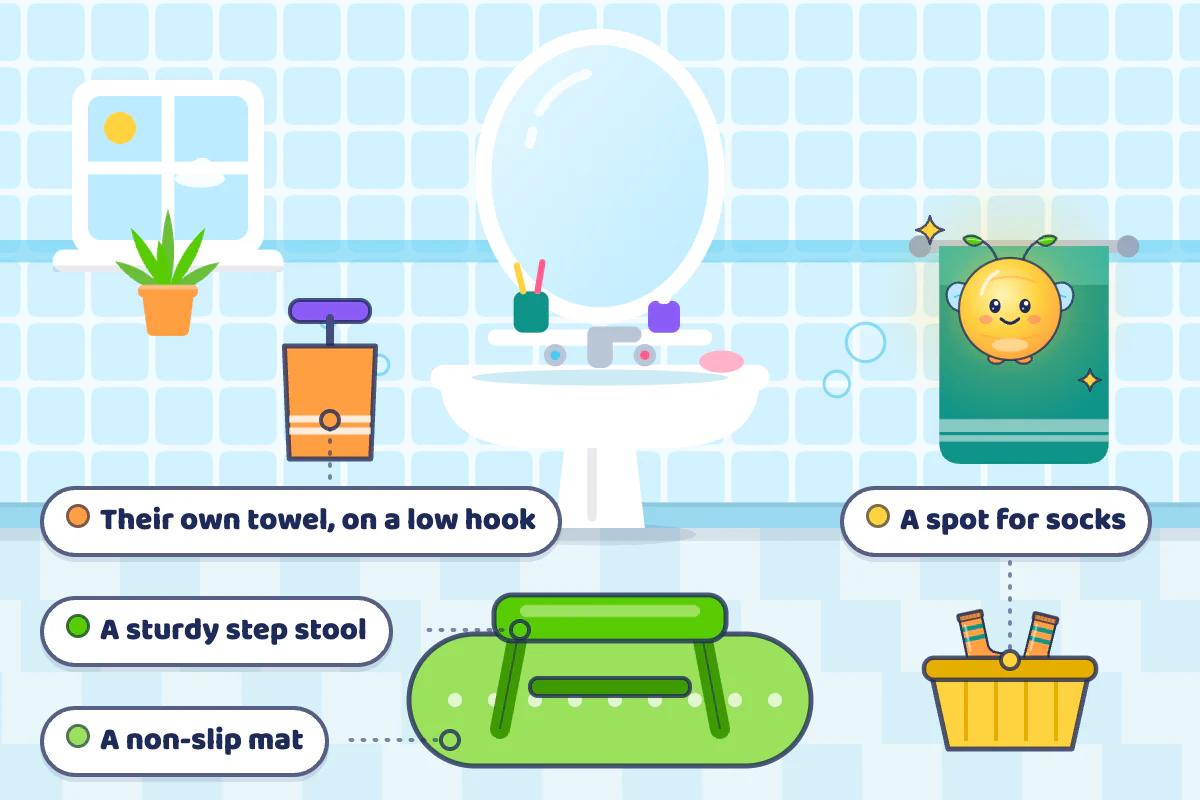
A lot of the struggle comes from a bathroom set up for adults. A few small changes help a child manage on their own:
- A sturdy step stool, so they can reach the tap without stretching or climbing on the edge of the sink.
- A non-slip mat on the floor, because wet floors and socks are slippery.
- Their own towel on a low hook they can reach.
- A spot for socks so they don't end up in a puddle.
- A clear counter, without toothbrushes and cups in the way.
A quick safety check: make sure the step stool can't slide, that the water isn't too hot (a grown-up can check the temperature first), and that nothing breakable sits near the sink. Children this age are steady on their feet, but wet surfaces catch everyone out.
If you use a different place for wudu at home, the same ideas apply: something steady to stand on, something dry to stand on, and a towel within reach.
Habits that help
These are small, practical habits a 6 to 8 year old can learn and own:
- Roll up sleeves first. Above the elbow and tight enough to stay up. Practise with a long-sleeved jumper.
- Socks off and put aside in the same place each time.
- Open the tap gently. A thin, steady stream, not a gush. "As thin as a pencil" is a good picture.
- Turn the tap off when your hands aren't under it.
- Tell a grown-up about a drip. Children love being the family's drip detective.
- Dry off with the towel, not on clothes.
- Tidy up after. Wipe splashes, hang the towel back, put socks back on.
The water habits are worth extra attention. They're kind to the world, and they make the whole routine calmer. A fun way to practise is to play "drip detective" around the house for a week: your child checks the taps after everyone has used them and reports any drips. In Deenlumo's version, children follow the sound of dripping water until they find the tap that was left running.
When you're out, at a friend's house or at the masjid washroom, the same habits apply. Talk about it on the way: "Sleeves up, thin stream, tap off, wipe the splashes." Taking the routine to new places is how it becomes your child's own.
Building independence over a month
Independence comes step by step. Here's a gentle 4-week plan for the practical side:
| Week | Your child does | You do |
|---|---|---|
| 1 | Rolls up sleeves, takes off socks, climbs on the step stool safely | Stay right beside them and help with the tap |
| 2 | Opens and closes the tap gently, keeps the stream thin | Stand nearby and remind with a word or a gesture |
| 3 | Dries off, hangs the towel, wipes up splashes | Check at the end and praise what went well |
| 4 | Does the whole routine around wudu on their own | Stay within earshot and ask "How did it go?" |
Every child is different. Some will move faster, and some will need longer at a stage. That's fine.
Making it calm, not rushed
Rushing makes children splash, forget and get upset. A few ideas to slow things down:
- Start a few minutes earlier. A calm heads-up beats a last-minute shout.
- Use a short routine name. For example "sleeves, socks, stool, slow". Children like having a chant to follow.
- Lead by example. If children see you get ready calmly, they'll copy it.
- Keep it positive. If water goes everywhere, hand them a cloth and say "Let's wipe it together."
- Notice the effort. "You remembered to turn the tap off. That was careful."
Where to learn the steps
The steps of wudu, their order and the related rulings are best learned with a local imam or Islamic teacher, who can show your child in person and explain how your family's practice works. Weekend schools often teach wudu at this age too.
Deenlumo's Clean and Ready chapter has adventures called "What Is Wudu?" and "Wudu Step by Step", which introduce the idea in a simple way for 6 to 8 year olds. They're a starting point to talk about with your family and your child's teacher, not a replacement for them. You can find the chapter in our adventures.
FAQ
At what age can a child do wudu alone?
It depends on the child's independence skills more than their age. Many 6 to 8 year olds can manage the practical parts on their own: rolling up sleeves, reaching the tap with a step stool, controlling the water and drying off. Build these skills over a few weeks with you nearby. For the steps themselves, learn with your teacher or imam.
How can I help my child save water?
Show them how to open the tap gently to a thin stream, turn it off when they're not using it, and tell a grown-up about a dripping tap. A small cup or a "thin as a pencil" stream is a nice visual. Praise them when they remember, and practise the same habit when brushing teeth.
How do I make wudu less rushed?
Start getting ready a few minutes earlier, give a calm heads-up instead of a last-minute call, and set the space up in advance with the stool and towel in place. A short, predictable routine such as "sleeves, socks, stool, slow" helps children move steadily without feeling hurried.
Read next
---
How we wrote this. This article was written by the Deenlumo team and covers practical habits only. It does not teach the steps or rulings of wudu, and it is waiting for review by a religious reviewer before publication. For the steps and rulings, please learn with your local imam or teacher.